
Emergency Water Damage Restoration in Sioux Falls
Emergency water damage restoration in Sioux Falls and surrounding areas. Insurance billing accepted. Call (605) 965-2727.
Water damage emergency in Sioux Falls? Call now for emergency service. Our crew responds fast to stop the water and start drying your property.
Standing water doesn’t wait. Within the first hour after a pipe bursts or a washing machine hose lets go, water is already wicking into drywall, soaking into subfloor panels, and beginning to swell door frames. Within 24 to 48 hours, the conditions for mold colonization are in place. Water damage restoration is a race against that clock, and the margin between a clean, fully dried structure and a home that needs gut-and-rebuild is often measured in how quickly the right equipment gets on-site.
What Water Damage Restoration actually involves
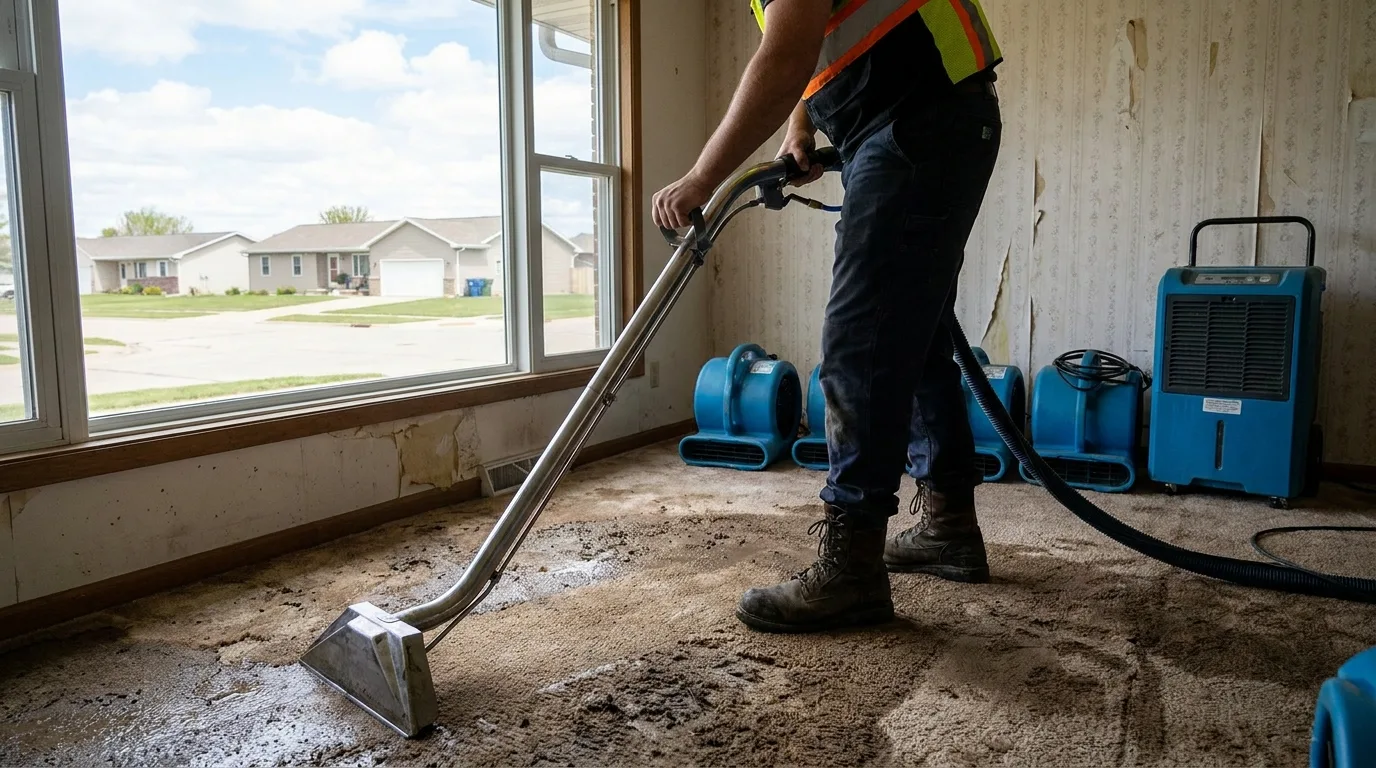
Water damage restoration is not mopping up and running a fan. At its core, it’s a controlled drying science. Technicians use truck-mounted or portable extractors to remove standing water, then deploy industrial air movers and low-grain refrigerant (LGR) or desiccant dehumidifiers to pull moisture out of materials that look dry but aren’t. Thermal imaging cameras and calibrated moisture meters map the full extent of the saturation, because water travels, and it almost always travels further than the visible damage suggests.
Timeline varies by category and material. A Category 1 loss (clean water from a supply line) in a single room with hardwood floors might dry in three to five days. A Category 2 loss (gray water from an overflowing dishwasher or toilet overflow) touching carpet, pad, and OSB subfloor can run seven to ten days of active drying. Category 3 losses, sewage backups, floodwater, require contaminated material removal before drying even begins, and the timeline extends accordingly.
Throughout the process, moisture readings are logged daily. Drying is not complete when the surface feels dry, it’s complete when the materials reach their documented dry standard.
Our process
-
Emergency water removal. The first priority is stopping active water intrusion (if the source hasn’t been shut off) and extracting standing water. Truck-mounted extractors can remove hundreds of gallons per hour. Portable units reach areas a truck mount can’t, crawl spaces, finished basements, upper floors.
-
Moisture mapping and documentation. Before a single dehumidifier is placed, technicians read every affected wall cavity, floor assembly, and ceiling with moisture meters and thermal imaging. This creates a baseline map that drives the drying plan and documents the scope for your insurance carrier.
-
Structural drying with monitored equipment placement. Air movers are positioned to create a vortex effect across wet surfaces; dehumidifiers are sized to the cubic footage of the drying chamber. Equipment isn’t set and forgotten, readings are taken every 24 hours and equipment is repositioned or scaled back as materials dry toward their target.
-
Category-appropriate containment and material removal. For Category 2 and Category 3 losses, saturated porous materials, carpet, pad, drywall below the flood cut line, are removed and disposed of before drying begins. Containment barriers may be erected to protect unaffected areas from cross-contamination.
-
Final moisture verification and clearance. When all materials reach their dry standard, a final moisture map is documented. This report goes to you and your adjuster as proof of completion, and it’s the foundation for any reconstruction scope that follows.
What separates a good water damage response from a bad one
The most common failure point in water damage restoration is incomplete drying, and it almost always comes from inadequate moisture mapping at the start. Technicians who skip thermal imaging or rely on visual inspection alone routinely miss water that has migrated behind baseboards, into wall cavities, or under hardwood flooring. That hidden moisture doesn’t disappear; it becomes a mold problem that surfaces weeks later, often after the homeowner thought everything was resolved.
A second common failure is under-sizing equipment. One residential dehumidifier from a hardware store is not a substitute for a properly calculated drying system. LGR dehumidifiers pull moisture at conditions that consumer units can’t match, and the grain depression they achieve is the difference between a five-day dry and a twelve-day dry, or no dry at all.
Insurance adjusters look for daily moisture logs, equipment placement records, and a documented dry standard. Without that paper trail, supplements and reinspection requests get complicated. A thorough documentation package protects the homeowner as much as it protects the contractor.
What does Water Damage Restoration cost?
Typical costs for water damage restoration vary significantly based on the size of the affected area, the category of water involved, and how much material removal is required. Most homeowners pay somewhere between $1,500 and $8,000 for a contained residential loss; larger or more contaminated losses run higher. The table below reflects typical industry ranges, not quotes from Crew Restoration & Construction.
| Scenario | Typical range |
|---|---|
| Single room, Category 1 (clean water), no material removal | $1,200 – $3,500 |
| Multi-room, Category 1, carpet and pad removed | $3,000 – $6,500 |
| Finished basement, Category 2 (gray water) | $4,500 – $10,000 |
| Category 3 (sewage / floodwater), partial gut required | $7,000 – $20,000+ |
| Crawl space water intrusion with insulation removal | $2,500 – $6,000 |
| Whole-house loss (burst pipe, appliance failure, multiple floors) | $10,000 – $30,000+ |
Every loss is different, and Crew Restoration & Construction provides a written scope of work before any work begins. Standard homeowners insurance policies typically cover sudden and accidental water damage, a burst pipe, a failed appliance supply line, an ice dam that breaches the roof, but generally exclude gradual leaks and ground-level flooding, which requires separate flood insurance.
Seasonal and regional considerations
Sioux Falls and the surrounding eastern South Dakota region see conditions that drive water damage claims in predictable patterns. Winter freeze-thaw cycles, particularly the hard freezes that hit uninsulated exterior walls and garage-adjacent plumbing, are a leading cause of burst pipe losses from November through March. Spring snowmelt combined with saturated soil pushes groundwater against foundation walls and through window wells, making sump pump failures a high-frequency event in March and April. Summer severe weather brings hail-damaged roofs that leak for weeks before the damage is discovered, leading to attic and ceiling losses that are already well along by the time a homeowner calls.
Homes in older Sioux Falls neighborhoods, particularly those built before 1980 in the core city, often have original cast iron drain lines that are prone to root intrusion and backup, and plaster-over-lath wall assemblies that hold moisture differently than modern drywall. Both factors affect drying timelines and should be accounted for in any restoration plan.
Service area
Crew Restoration & Construction is based in Sioux Falls and serves communities throughout the region, including Brandon, Tea, Harrisburg, Dell Rapids, Canton, and surrounding areas. Dedicated service-area pages cover the specifics of each community, this page covers the full scope of what water damage restoration involves, wherever the loss occurs.
If you’re seeing water on the floor, wet walls, or a ceiling that’s starting to sag, call (605) 965-2727 to schedule your moisture assessment. The sooner the drying process starts, the more structure and material can be saved.
Services We Handle
- Attic Water Damage Cleanup
- Carpet Water Extraction
- Dry Out
- Drying Water Damaged Property
- Drywall Water Damage Cleanup
- Emergency Water Damage Cleanup
- Emergency Water Mitigation
- Hardwood Floor Water Damage
- Home Water Damage
- House Water Damage
- Laminate Floor Water Damage
- Structural and Moisture Mitigation
- Structural Drying
- Vapor Barrier
- Water and Moisture Control
- Water Damage
- Water Damage Cleanup Repair
- Water Damage Drying
- Water Damage Flooring
- Water Damage Repair
- Water Damage Repairs and Restoration
- Water Damage Under Flooring
- Water Removal
- Wet Drywall Repair
- Winter Water Damage
- Wood Floor Water Damage Repair
Frequently Asked Questions
Does homeowners insurance cover water damage restoration?
How long does structural drying typically take, and what affects the timeline?
What's the difference between Category 1, 2, and 3 water damage, and why does it matter for cleanup?
What should I do — and not do — while waiting for the restoration crew to arrive?
How do technicians know when a structure is actually dry — and why can't you just go by feel?
Watch: Water Damage Restoration in Sioux Falls
Looking for the best water damage restoration company in Sioux Falls?
Crew Restoration & Construction provides licensed and insured water damage restoration in Sioux Falls, SD and the surrounding area, and has served local property owners since 2015. Customers rate us 4.9 out of 5 stars across 647 Google reviews. We answer calls 24/7 — call (605) 965-2727 for immediate help.
Request a Free Water Damage Restoration Estimate
Tell us what happened and we'll get back to you fast — usually within one business hour.
Need Water Damage Restoration now?
We respond 24/7 across Sioux Falls and surrounding SD cities.
Related Coverage
- Our Restoration Services
- Mold Remediation in Sioux Falls
- Emergency Water Removal & Cleanup in Sioux Falls
- Emergency Flood Damage Restoration in Sioux Falls
- Contact Crew Restoration & Construction
- Emergency Water Damage Restoration in Brandon
- Emergency Water Damage Restoration in Brookings
- Emergency Water Damage Restoration in Canton
- Emergency Water Damage Restoration in Dell Rapids
- Emergency Water Damage Restoration in Flandreau
- Emergency Water Damage Restoration in Harrisburg
- Emergency Water Damage Restoration in Hartford
- Emergency Water Damage Restoration in Le Mars
- Emergency Water Damage Restoration in Lennox
- Emergency Water Damage Restoration in Luverne
- Emergency Water Damage Restoration in Madison
- Emergency Water Damage Restoration in North Sioux City
- Burst Pipe Checklist: Step-by-Step Response
- What To Do in the First 24 Hours After Water Damage
- How To Choose a Restoration Company in Sioux Falls (Without Getting Burned)