Emergency Water Removal & Cleanup in Sioux Falls
emergency water removal and cleanup in Sioux Falls and surrounding areas. IICRC-certified, insurance billing accepted. Call (605) 965-2727.
Standing water does not wait. Within the first hour, it migrates under baseboards, wicks into drywall, and begins saturating subfloor assemblies that can look and feel dry at the surface. By 24 hours, Category 1 clean water from a burst supply line can degrade into Category 2 as it picks up contaminants from building materials and household debris. The goal of emergency water removal and cleanup is not just to remove what you can see, it is to stop saturation from advancing into the structural cavities where drying becomes exponentially harder and mold colonization can begin within 48 to 72 hours.
What emergency water removal and cleanup actually involves
Emergency water removal is not mopping and running a fan. A proper response combines high-capacity extraction, psychrometric drying science, and continuous moisture monitoring across multiple material assemblies at once.
The equipment on an emergency water removal job includes truck-mounted or portable extraction units capable of removing hundreds of gallons from carpet and pad, axial and centrifugal air movers positioned to create a directed drying envelope, and refrigerant or desiccant dehumidifiers sized to the cubic footage of the affected space. Thermal imaging cameras reveal moisture migration behind walls that a surface moisture meter will miss entirely. Penetrating moisture meters track readings inside framing, subfloor, and concrete slab so the drying curve can be documented day by day.
Timeline varies by water category, material porosity, and how quickly extraction begins. A single-room clean-water loss caught within a few hours may reach drying goals in three to five days. A Category 2 loss involving contaminated water, or any loss where water sat undetected for more than a day, routinely requires five to seven days of active drying and may require selective demolition of saturated assemblies that cannot be dried in place.
Our process
-
Loss assessment and water categorization. The source of water determines the safety protocols and cleaning requirements for everything that follows. Clean water from a supply line, gray water from an appliance drain or toilet overflow, and black water from sewage or floodwater each require a different response. Crew Restoration & Construction’s IICRC-certified technicians identify the category on arrival and document the affected area with moisture mapping before extraction begins.
-
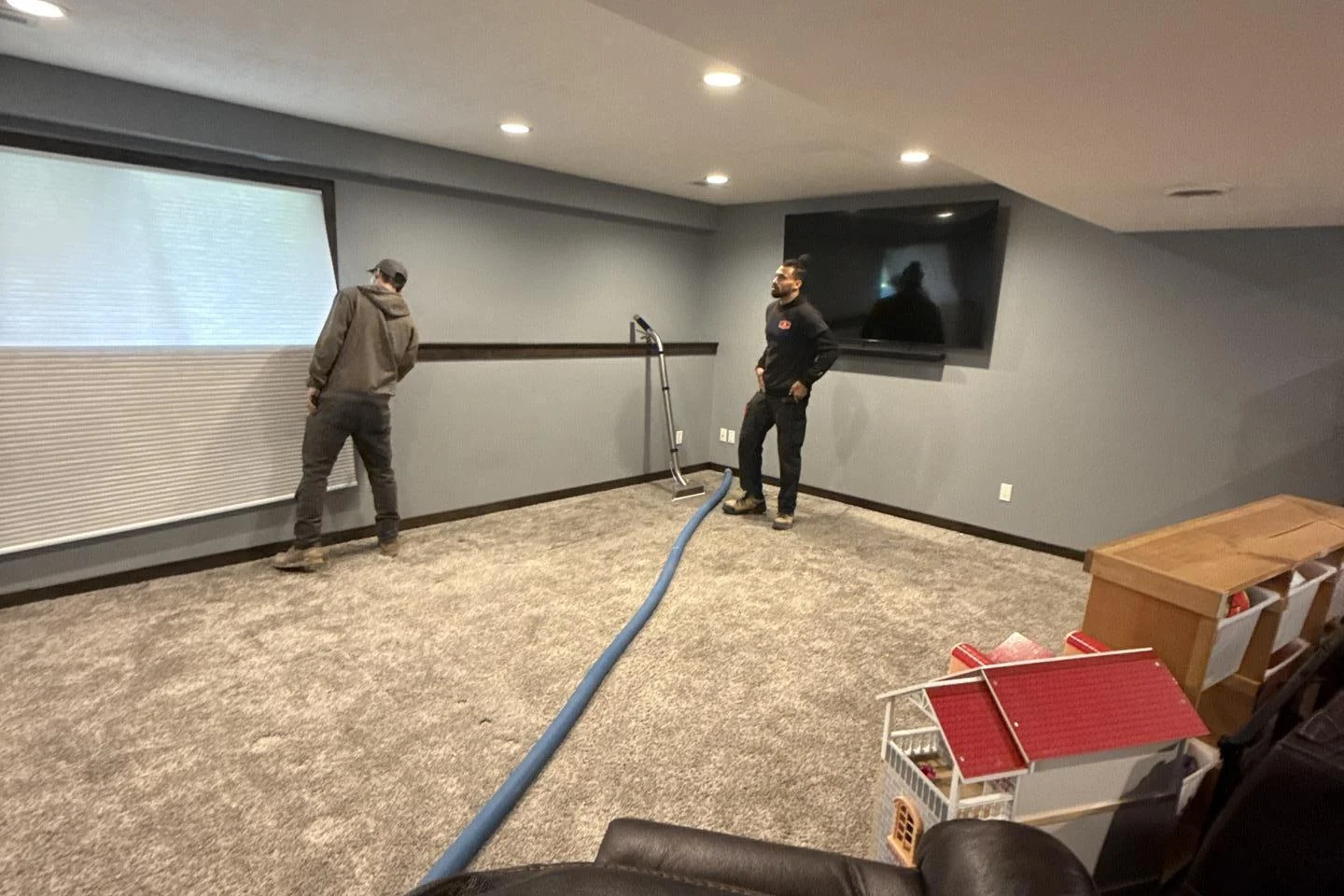
Standing water and bulk extraction. Truck-mounted extraction removes standing water from hard surfaces and saturated carpet assemblies as quickly as possible. Speed here directly limits how far saturation has migrated into adjacent materials. Carpet pad almost always requires removal, it holds water at a volume that air movers cannot overcome and becomes a contamination source if left in place.
-
Structural drying setup. Air movers and dehumidifiers are placed according to the drying plan, not simply distributed across the room. The goal is a controlled drying envelope: warm, dry air moving across wet surfaces, with the resulting humid air captured by dehumidifiers before it can re-deposit moisture into unaffected materials. Wall cavities that read elevated on thermal imaging are opened or drilled for directed airflow where needed.
-
Daily moisture monitoring and documentation. Readings are logged at the same reference points each visit. Insurance carriers and adjusters rely on this daily moisture log to confirm that drying met the IICRC S500 standard and that equipment was on-site for the documented duration. Without this record, supplement claims for additional drying days or hidden damage repairs become difficult to support.
-
Antimicrobial treatment and clearance. Once materials reach drying goals, affected surfaces are treated with EPA-registered antimicrobial agents appropriate to the water category. For Category 2 and Category 3 losses, this step is required, not optional. Final moisture readings confirm clearance before equipment is removed and the scope of any needed reconstruction is documented.
What separates a good water removal and cleanup response from a bad one
The most common failure in emergency water removal is stopping at what is visible. A crew that extracts standing water, runs equipment for two days, and declares the job complete without daily moisture logs has left the property owner with no documentation and potentially with wet framing or subfloor that will grow mold behind finished surfaces.
A second common problem is under-sizing equipment. One air mover per room is not a drying plan. The IICRC S500 standard provides formulas for equipment placement based on affected square footage, material type, and ambient conditions. Skipping that math means extended drying times and a higher likelihood of secondary damage.
Insurance adjusters reviewing a water claim look for the moisture log, the equipment placement diagram, the water category determination, and photo documentation of affected materials before and after demolition. A claim file that is missing any of these elements creates friction at every supplement request. Thorough documentation from day one is what keeps a claim moving.
Finally, Category 2 and Category 3 water losses require antimicrobial treatment of affected materials and proper disposal of contaminated contents. Treating a sewage backup or floodwater loss with the same protocol as a clean-water pipe burst is a safety and liability issue, not just a quality issue.
What does emergency water removal and cleanup cost?
Typical costs for emergency water removal and cleanup depend heavily on the water category, the size of the affected area, how long water was present before extraction began, and whether structural drying can be done in place or requires demolition. Most homeowners pay somewhere in the ranges below for the extraction and drying phase alone, before any reconstruction.
| Scenario | Typical industry range |
|---|---|
| Single room, clean water (Category 1), caught early | $1,200 - $3,500 |
| Multi-room clean water loss, subfloor involved | $3,500 - $7,000 |
| Category 2 loss (appliance overflow, toilet backup) | $4,000 - $9,000 |
| Category 3 loss (sewage, floodwater), partial demo required | $7,000 - $20,000+ |
| Finished basement, standing water, extended saturation | $5,000 - $15,000 |
| Crawl space or slab moisture intrusion | $2,500 - $8,000 |
These are typical industry figures based on published restoration cost data. Every loss is different, and Crew Restoration & Construction provides a written scope of work before any work begins. Homeowners insurance typically covers sudden and accidental water losses, including burst pipes and appliance failures, but generally excludes gradual leaks and flood events, which require separate flood insurance coverage.
Seasonal and regional considerations
Sioux Falls and the surrounding eastern South Dakota region present specific water damage patterns worth knowing. The freeze-thaw cycle from late November through March is the primary driver of burst pipe losses: supply lines in exterior walls, garage spaces, and crawl spaces are vulnerable when temperatures drop sharply overnight. Spring snowmelt, particularly in April, creates saturated soil conditions that push water through foundation cracks and window wells in older neighborhoods. Summer severe weather brings intense, fast-moving storms that can overwhelm sump pumps and drainage systems within minutes.
Homes built before the 1980s in established Sioux Falls neighborhoods often have galvanized steel supply lines and cast iron drain stacks that are approaching the end of their service life, making pipe failures more common. Homes with finished basements, which are standard across the region, face a higher consequence from any water intrusion because finished assemblies trap moisture and are slower to dry than open framing.
Service area
Crew Restoration & Construction provides emergency water removal and cleanup in Sioux Falls and throughout the surrounding region, including Brandon, Tea, Harrisburg, Renner, Crooks, Dell Rapids, and Baltic. Each service-area page covers local routing and response details specific to that community.
If you are looking at water on your floor right now, call (605) 965-2727 to schedule your moisture assessment and get a crew moving toward your property.
Services We Handle
- Carpet Water Damage
- Ceiling Water Cleanup
- Clogged Drain Overflow Cleanup
- Dishwasher Overflow
- Drain and Sink Overflow Cleanup
- Emergency Water Restoration
- Kitchen Sink Overflow Cleanup
- Plumbing Overflow
- Plumbing Overflow Cleanup
- Refrigerator Leak Cleanup
- Remove Water
- Shower and Tub Overflow Cleanup
- Sink Overflow Cleanup
- Sink Overflow Restoration
- Standing Water Removal
- Washing Machine Leak Cleanup
- Water Cleanup
- Water Emergencies
- Water Extraction
- Wet Carpet
- Wet Carpet Drying
- Wet Carpet Dryout
Frequently Asked Questions
Does homeowners insurance cover emergency water removal and structural drying?
How long does structural drying typically take after a water loss?
What is the difference between Category 1, Category 2, and Category 3 water, and why does it matter for removal and cleanup?
Can water under flooring or behind walls be dried without tearing out the materials?
What should I do while waiting for the emergency water removal crew to arrive?
Looking for the best emergency water removal & cleanup company in Sioux Falls?
Crew Restoration & Construction provides licensed and insured emergency water removal & cleanup in Sioux Falls, SD and the surrounding area, and has served local property owners since 2015. Customers rate us 4.9 out of 5 stars across 643 Google reviews. We answer calls 24/7 — call (605) 965-2727 for immediate help.
Request a Free Emergency Water Removal & Cleanup Estimate
Tell us what happened and we'll get back to you fast — usually within one business hour.
Need Emergency Water Removal & Cleanup now?
We respond 24/7 across Sioux Falls and surrounding SD cities.
Related Coverage
- Our Restoration Services
- Contact Crew Restoration & Construction
- Emergency Water Removal & Cleanup in Adrian
- Emergency Water Removal & Cleanup in Akron
- Emergency Water Removal & Cleanup in Alton
- Emergency Water Removal & Cleanup in Baltic
- Emergency Water Removal & Cleanup in Beresford
- Emergency Water Removal & Cleanup in Brandon
- Emergency Water Removal & Cleanup in Brookings
- Emergency Water Removal & Cleanup in Canton
- Emergency Water Removal & Cleanup in Crooks
- Emergency Water Removal & Cleanup in Dakota Dunes
- Emergency Water Removal & Cleanup in Dell Rapids
- Emergency Water Removal & Cleanup in Edgerton
- Emergency Water Damage Restoration in Sioux Falls