TL;DR: Water damage restoration in Sioux Falls, SD typically costs $1,500 to $8,500 for most residential losses. A single room with clean water runs $1,200 to $3,500. A finished basement with contaminated water can reach $10,000 or more. Your homeowners policy usually covers the restoration minus your deductible, as long as the source was sudden and accidental. The water category, affected square footage, and materials involved are the three biggest cost drivers.
If you just found standing water in your home and you’re trying to figure out what this is going to cost before you call anyone, you’re in the right place. Restoration pricing feels opaque because every loss is different. This guide breaks down what actually moves the number in Sioux Falls, what a typical insurance payout looks like, and what you can expect when a crew shows up.
How Much Does Water Damage Restoration Cost in Sioux Falls?
Most Sioux Falls homeowners pay between $1,500 and $8,500 for water damage restoration, with the national average hovering around $3,000 to $4,500 for a mid-size residential loss. Smaller, clean-water losses in a single room often come in under $2,500. Finished basements, Category 2 or 3 water, or losses that sat undetected for days can push well past $10,000.
Here’s a scenario-based breakdown of typical ranges:
| Scenario | Typical Cost Range |
|---|---|
| Single room, clean water (Category 1), hard floors | $1,200 - $3,500 |
| Single room, clean water, carpet + pad | $1,800 - $4,500 |
| Two or more rooms, Category 1 water | $3,500 - $7,000 |
| Finished basement, Category 1 or 2 water | $5,000 - $12,000 |
| Category 2 water (gray water, appliance overflow) | $3,000 - $8,000 |
| Category 3 water (sewage, floodwater) | $7,000 - $20,000+ |
| Crawl space drying + encapsulation | $2,500 - $6,000 |
| Hidden moisture behind walls, no visible damage | $1,500 - $4,000 |
These are typical industry figures for the Sioux Falls market. Every loss is different, and Crew Restoration & Construction provides a written scope before any work begins.
What Factors Drive the Final Number?
Four things move the cost more than anything else: water category, affected square footage, the materials involved, and how fast you called.
Water category is the biggest single variable. The IICRC S500 standard defines three categories. Category 1 is clean water from a supply line or appliance. Category 2, also called gray water, comes from dishwashers, washing machines, or toilet overflows without solid waste. Category 3, called black water, includes sewage backups, floodwater, and any water that has sat long enough to grow bacteria. Category 3 requires full PPE, antimicrobial treatment, and often complete material removal rather than drying in place. That difference in protocol is why a sewage backup in a McKennan Park basement costs three to four times more than a burst supply line in the same space.
Affected square footage and class of loss matter almost as much. The IICRC also classifies losses by how much moisture has migrated into materials. Class 1 means a small area with minimal absorption. Class 4 means materials like hardwood, concrete, or plaster have absorbed water deeply and require specialty drying. A Class 1 loss in a Prairie Green laundry room is a one-day job. A Class 3 loss where water wicked up drywall 24 inches in a finished basement is a multi-week project.
Materials affected determine how much comes out and how much gets rebuilt. Vinyl plank flooring over a concrete slab is often salvageable. Hardwood floors that have cupped require monitoring and sometimes full replacement. Insulated exterior walls in older Whittier or Cathedral Historic District homes hold moisture longer and cost more to dry properly.
Response time is a cost multiplier most homeowners don’t think about. Water that sits 48 to 72 hours begins growing mold. What was a $3,000 drying job becomes a $3,000 drying job plus mold remediation on top. Getting extraction started within the first few hours is the single best way to keep the final invoice lower. See our guide on what to do in the first 24 hours after water damage for the steps that protect your claim and your home.
What Does Insurance Typically Cover?
Most standard homeowners policies in South Dakota cover sudden and accidental water damage from internal sources. That means a burst pipe, a failed water heater, an appliance supply line that let go, or an ice dam that forced water through the roof. The policy pays for extraction, drying, demolition of unsalvageable materials, and reconstruction, minus your deductible.
What policies typically exclude: gradual leaks (a slow drip behind a cabinet that went unnoticed for months), ground-level flooding from rain or snowmelt, and sewer backups unless you added a sewer backup rider. Flood damage from rising water requires a separate NFIP policy through the National Flood Insurance Program.
Here’s how the insurance math usually works in practice. If the total restoration scope is $6,000 and your deductible is $1,500, you pay $1,500 and the insurer covers $4,500. The restoration company documents the loss, provides a written scope of work, and communicates directly with the adjuster. That documentation is what protects your claim. Gaps in documentation are the most common reason claims get reduced or disputed.
A few things worth knowing before you call your insurer:
- Call the restoration company first, then your insurer. Mitigation needs to start immediately. Most policies require you to take reasonable steps to prevent further damage. Waiting for an adjuster to arrive before starting extraction can jeopardize your claim.
- Keep records of everything. Photos before anything is moved, photos during extraction, moisture readings at each stage. A good restoration crew handles this automatically.
- Your deductible applies per occurrence, not per year. One water loss, one deductible.
- Betterment clauses can reduce payouts if the insurer determines the repair upgrades materials beyond their pre-loss condition. This comes up most often with older flooring or cabinets.
For a deeper look at what South Dakota policies actually pay, see our post on whether homeowners insurance covers water damage.
What Does the Restoration Process Actually Look Like?
Understanding the phases helps you know what you’re paying for and why the timeline matters. The IICRC S500 is the industry standard that governs how water damage is assessed and dried.
- Emergency extraction. Truck-mounted or portable extractors remove standing water. This is the fastest phase and the most important for limiting damage spread.
- Moisture mapping. Technicians use thermal imaging cameras and pin-type moisture meters to map exactly where water has migrated, including inside walls and under flooring. You can’t dry what you haven’t found.
- Demolition of unsalvageable materials. Saturated drywall, insulation, and flooring that can’t be dried in place are removed. This is called “flood cuts” when it’s drywall. Removing wet materials speeds drying and prevents mold.
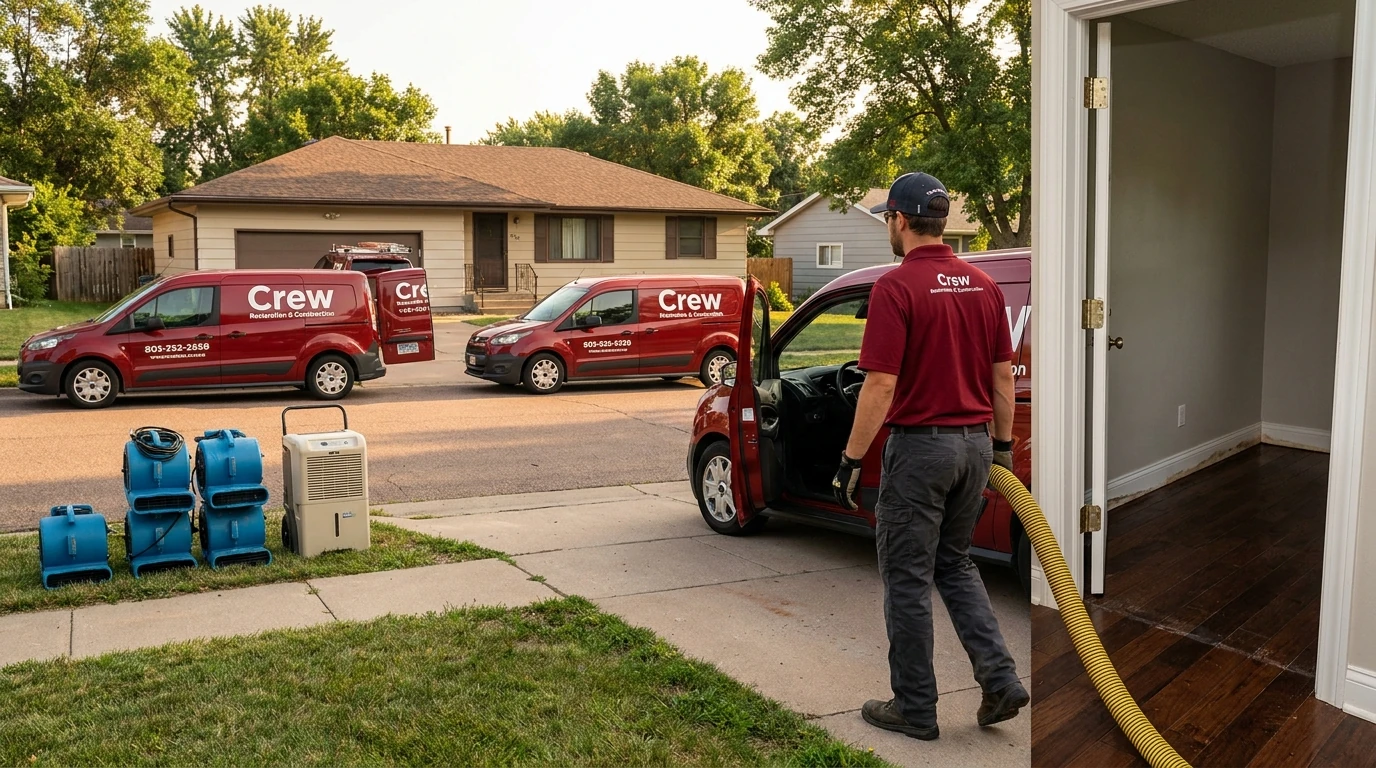
- Structural drying. Industrial LGR (low-grain refrigerant) dehumidifiers and high-velocity air movers run continuously, often for 3 to 5 days for a standard loss. Technicians return daily to take moisture readings and adjust equipment placement.
- Antimicrobial treatment. Applied to affected surfaces, especially for Category 2 or 3 losses.
- Clearance testing. Final moisture readings confirm the structure has returned to normal dry standard before reconstruction begins.
- Reconstruction. Drywall, flooring, paint, trim, and any structural elements are rebuilt to pre-loss condition. This phase is where general contracting work begins.
For a full breakdown of how long each phase takes, see how long water damage restoration actually takes.
What Should You Do Right Now?
If the loss just happened, the steps you take in the next two hours matter more than anything else for both the outcome and the cost. Stop the water source if it’s still running. Move valuables out of the wet area. Don’t run fans from your garage into a soaked space (that spreads contamination and can push moisture into unaffected areas). Document everything with photos before anything is touched.
Then call a certified restoration company to start extraction. The longer water sits in Sioux Falls homes, especially in finished basements or homes with older materials, the more the scope grows. Mold can begin developing within 24 to 48 hours in the right conditions.
Crew Restoration & Construction serves the Sioux Falls metro, including neighborhoods like McKennan Park, All Saints, and the Cathedral Historic District. Their IICRC-certified crews handle water damage restoration, mold remediation, sewage cleanup, and reconstruction. Request a water damage assessment at (605) 965-2727 or get a written scope started at [email protected].
About Crew Restoration & Construction
Crew Restoration & Construction is an IICRC-certified restoration company serving Sioux Falls, SD and the surrounding region since 2015 (license 3814). Their crews handle water damage restoration, mold remediation, fire damage restoration, storm damage restoration, sewage cleanup, biohazard cleanup, asbestos abatement, roofing, siding, contents restoration, and general contracting across the metro and into neighboring communities in SD, IA, and MN.