
TL;DR: Dry rot is a wood-destroying fungus that needs moisture to start but can keep spreading through dry lumber once established. Early signs include a white or gray cotton-like growth (mycelium) in damp, poorly ventilated spaces. Later stages show an orange, mushroom-like fruiting body with rusty red spores. Advanced dry rot leaves wood deeply cracked, brittle, and crumbly to the touch, with an earthy odor. Because it spreads faster and farther than wet rot, catching it early matters.
If you’ve noticed a strange chalky residue under a windowsill, a soft spot on your deck boards, or a musty smell coming from the crawlspace, you’re probably not imagining it. Dry rot often starts in spaces you never look at, attics, subfloors, behind baseboards, and it’s already done real damage by the time it becomes visible. Here’s what to look for and what each stage actually means.
What does dry rot look like in the early stages?
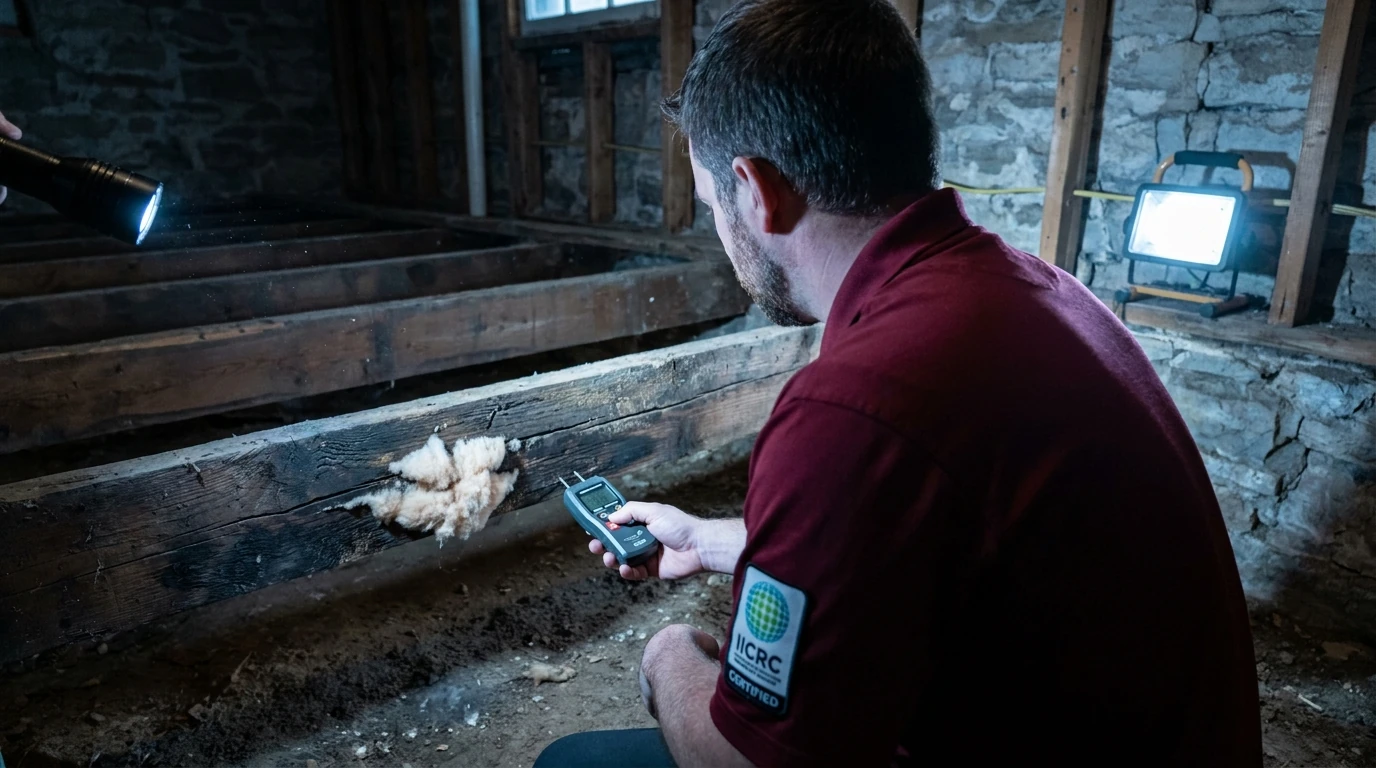
The earliest visible sign of dry rot is mycelium growth, a white or grayish substance that looks like clumps of cotton or spiderweb spreading across wood, masonry, or even insulation. It isn’t limited to the wood itself. Because the fungus is hunting for its next food source, you may see these strands creeping across a foundation wall or a pipe toward a fresh piece of lumber.
Mycelium usually shows up in damp, low-ventilation areas first: under floor joists, inside a crawlspace, behind a finished basement wall. It can be present for months before a homeowner ever sees it, because nobody’s crawling under the subfloor on a normal Tuesday. By the time you notice a cottony patch, the fungus has likely already been feeding on nearby wood for a while.
What does advanced dry rot look like?
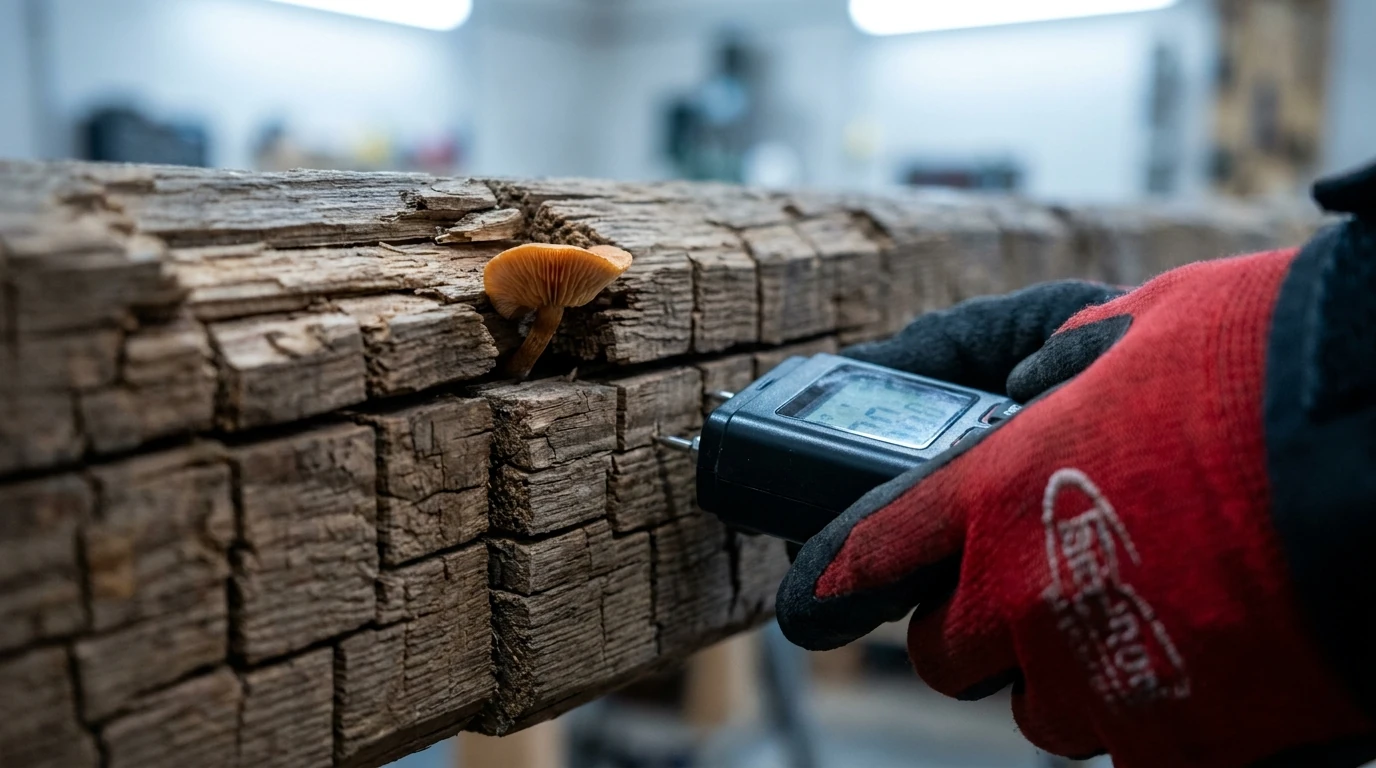
Advanced dry rot produces a fruiting body, a distinct, mushroom-like growth with an orange-tinted surface that releases rusty-red spores as it matures. This is the fungus’s reproductive stage, and it’s a sign the infestation has progressed well past the early warning phase.
Once spores spread, the fungus can jump to new, previously unaffected wood nearby. At this stage the wood itself often shows deep, cross-grain cracking (sometimes called cuboidal cracking) and becomes dry, light, and brittle. Press a screwdriver into a suspect joist or sill plate. If it sinks in easily or the wood crumbles instead of splintering, that’s advanced decay, not just surface staining.
How is dry rot different from wet rot?
Dry rot spreads farther and causes more structural damage than wet rot, because it can travel beyond the original wet area in search of new wood. Wet rot stays confined to the specific spot that’s staying damp.
Wet rot shows up as a dark brown to black fungal growth, with wood that feels spongy or damp to the touch and gives off a distinct musty odor. Dry rot, depending on the stage, shows either the white cotton-like mycelium or the orange, mushroom-like fruiting body, paired with a drier, earthy smell and that telltale brittle, crumbling texture. Both can compromise a structure’s framing, decking, or subfloor, but dry rot’s ability to spread through masonry and still-dry lumber is why restoration crews treat it as the more serious call.
Where does dry rot tend to show up in Sioux Falls homes?
Dry rot shows up anywhere wood stays damp with poor airflow: the attic, flooring, stairs, crawlspaces, and anywhere else there is wood. The places you can actually see it are usually windows, exposed wood in the basement, and your deck.
Dry rot starts when wood stays too wet, so a roof or pipe leak is often the beginning of the problem. If you’ve had a slow leak you weren’t sure about, it’s worth reading our guide on identifying a water leak before the moisture problem turns into a wood problem. And if what you’re actually seeing looks more like a dark, fuzzy growth than a brittle crack, it may be worth comparing notes against our black mold vs. regular mold breakdown first.
When is dry rot too far gone to fix yourself?
Dry rot is a job for a professional once the wood is structural (joists, sill plates, deck framing, stair stringers) or once you can’t find and fully stop the moisture source yourself. Cutting out a visibly rotted board without resolving the leak behind it just sets up a repeat problem.
A proper fix has four parts: find and stop the moisture source, whether that’s a roof leak, a plumbing leak, or grading that’s pushing water toward the foundation; dry the surrounding structure completely, not just the visibly wet section; remove every piece of affected wood, since fungal strands can extend past what looks damaged; and replace the timber with new material tied back into sound framing. Skipping any one of those steps lets the fungus restart. Crew Restoration & Construction’s reconstruction crews handle exactly this sequence, assessing the extent of the damage, drying the structure, and rebuilding the framing so the repair actually holds.
If you’re staring at crumbling wood in your attic or a soft spot on a deck board and you’re not sure how far it’s spread, it’s worth getting a second set of eyes on it before you start cutting into anything load-bearing.
About Crew Restoration & Construction
Crew Restoration & Construction is an IICRC-certified reconstruction and restoration company (license #3814) based in Sioux Falls, SD, serving the metro and surrounding communities since 2015. Led by Kyle Eberts, the Crew team handles structural repair, water damage restoration, mold remediation, and reconstruction work across the region.
Need help now? Call Crew Restoration & Construction at (605) 965-2727.