
Water Leak Detection in Sioux Falls
Water leak detection in Sioux Falls and surrounding areas. IICRC-certified, insurance billing accepted. Call (605) 965-2727.
A water bill that jumps for no clear reason, a patch of laminate that’s started to cup near the kitchen, a musty smell in the hallway closet with no visible water anywhere. These are the calls that don’t fit neatly into a water damage job because there’s no standing water to extract yet, just a leak somewhere in the wall, under the slab, or behind a fixture that’s been running long enough to cause damage without ever showing itself. Finding that leak before it becomes a bigger repair is its own specialized skill, and it’s different work than drying out a flood.
What water leak detection actually involves
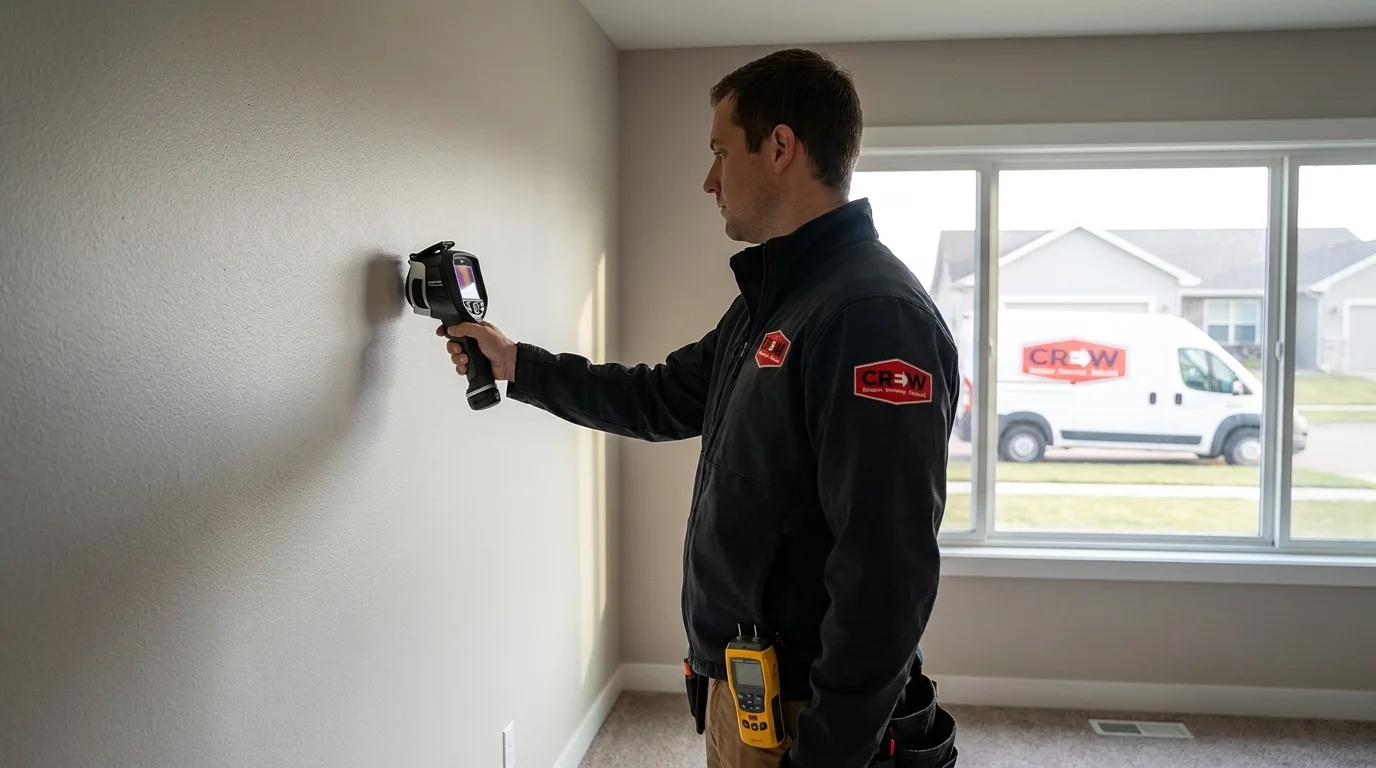
Locating a hidden leak means finding water you can’t see using equipment built to read what’s happening inside walls, under flooring, and beneath concrete slabs. A thermal imaging camera picks up temperature differences where moisture is cooling a wall cavity. A moisture meter maps out how far water has traveled from its source, which often isn’t where the stain shows up. For slab leaks, an electronic listening device picks up the sound of pressurized water escaping a supply line under concrete, a sound that’s inaudible to the human ear but distinct through the right microphone. A typical assessment runs an hour or two on site depending on the size of the home and how many potential source points need to be checked (supply lines, drain lines, fixture connections, roof penetrations, and slab plumbing).
Our process
- Symptom review. We start by asking what prompted the call: a water bill spike, a sound of running water with everything off, a smell, a soft spot in flooring. That narrows down where to start looking.
- Non-invasive scanning. Thermal imaging and moisture meters map the affected area first, without cutting into anything, to establish a pattern of where moisture is concentrated.
- Acoustic and pressure testing. For suspected slab or in-wall plumbing leaks, we use listening equipment and, where appropriate, isolate and pressure-test plumbing lines to confirm which line is compromised.
- Pinpointing. Once the readings converge on a location, we mark the exact spot, sometimes confirming with a small inspection opening rather than opening an entire wall or section of flooring.
- Written findings. You get a report showing what we found, where, and what it will take to access and repair it, so a plumber or our own crew can move straight to repair without re-diagnosing the problem.
What separates a good leak detection response from a bad one
The most common mistake is skipping the diagnostic step and going straight to demolition based on where a stain appeared on the ceiling or wall. Water travels along framing, insulation, and subfloor before it shows up visually, so the wet spot on drywall is frequently several feet from the actual leak. That leads to cut-open walls in the wrong location and a homeowner paying for repairs twice. A second issue is not checking for a second leak path: a slow leak that’s been running for weeks can already have caused conditions for mold growth in a wall cavity, and an operator who patches the pipe without checking the surrounding material misses that. Insurance adjusters reviewing a claim want to see documented moisture readings, thermal images, and a clear timeline showing when the leak was found and addressed, not just a repair invoice. That documentation is also what protects a homeowner if the same area shows problems again later.
What does water leak detection cost?
Costs vary based on how accessible the suspected leak is, whether it’s a single fixture or a whole-house survey, and whether the leak is under a slab. These are typical industry ranges, not a quote. Every property is different, and Crew Restoration & Construction provides a written scope before any work begins. Homeowners insurance typically covers the cost of locating a leak when it’s tied to a covered water damage claim, though policies vary on whether detection alone is covered absent resulting damage.
| Scenario | Typical range |
|---|---|
| Single fixture or appliance leak | $250 - $600 |
| Leak in wall, single room | $350 - $800 |
| Slab leak detection | $400 - $900 |
| Whole-house moisture survey | $500 - $1,200 |
| Detection plus follow-up moisture mapping | $600 - $1,500 |
Seasonal & regional considerations
Sioux Falls winters put real stress on plumbing that runs through unheated crawl spaces, garages, and exterior walls, and a pipe that develops a pinhole leak from freeze expansion in January often isn’t discovered until the spring thaw, when the water bill jumps or a floor finally shows damage. Homes on slab foundations, more common in newer developments around the city, are also worth checking periodically since a slab leak can run for months with no visible sign beyond a warm spot on the floor or a higher water bill.
Service area
We locate hidden leaks for homeowners and property managers throughout Sioux Falls and the surrounding communities, including Tea, Harrisburg, Brandon, and Dell Rapids.
If your water bill doesn’t add up, a floor feels warm in one spot, or you can hear water running somewhere you can’t see, schedule a leak detection assessment before the damage spreads any further. Call Crew Restoration & Construction at (605) 965-2727.
Services We Handle
- A/C Unit Drain Overflow
- A/C Unit Overflow
- Air Conditioner Condenser Leak
- Moisture Readings
Frequently Asked Questions
Does homeowners insurance cover water leak detection?
How do you find a leak without cutting open my walls or floors?
What's different about detecting a slab leak versus a leak in a wall?
What are the signs I might have a hidden water leak?
How long does a leak detection appointment take?
Looking for the best water leak detection company in Sioux Falls?
Crew Restoration & Construction provides licensed and insured water leak detection in Sioux Falls, SD and the surrounding area, and has served local property owners since 2015. Customers rate us 4.9 out of 5 stars across 643 Google reviews. We answer calls 24/7 — call (605) 965-2727 for immediate help.
Request a Free Water Leak Detection Estimate
Tell us what happened and we'll get back to you fast — usually within one business hour.
Need Water Leak Detection now?
We respond 24/7 across Sioux Falls and surrounding SD cities.
Related Coverage
- Our Restoration Services
- Contact Crew Restoration & Construction
- Restoration Services in Adrian
- Restoration Services in Akron
- Restoration Services in Alton
- Restoration Services in Baltic
- Restoration Services in Beresford
- Restoration Services in Brandon
- Restoration Services in Brookings
- Restoration Services in Canton
- Restoration Services in Crooks
- Restoration Services in Dakota Dunes
- Restoration Services in Dell Rapids
- Restoration Services in Edgerton