TL;DR: For smoke damage in Sioux Falls, SD, call a licensed, IICRC-certified restoration company before you call your insurance adjuster. Restoration crews stop soot from etching into surfaces, document the damage for your claim, and handle odor removal that household cleaners can’t touch. Call 911 first if there’s active fire, gas smell, or structural damage. Otherwise, the restoration call comes first; the insurance call comes second.
If you’re standing in your kitchen right now looking at a soot-streaked ceiling from a grease fire, or you just noticed a layer of black dust on every windowsill after your furnace puffed back, you’re probably wondering who actually handles this. It’s not your homeowner’s insurance company, and it’s usually not a general cleaning service either. Crew Restoration & Construction, an IICRC-certified restoration company based in Sioux Falls, is a direct line for fire and smoke cleanup across McKennan Park, Whittier, and the rest of the metro, and they’re available 24/7. Call (605) 965-2727.
Who do I call first: the fire department, insurance, or a restoration company?
Call 911 first only if there’s active fire, visible flame, or a gas odor; everything else comes after the property is safe to re-enter. Once the fire department has cleared the scene, the next call is a restoration company, not your insurance adjuster, because soot keeps working on your home the longer it sits.
Soot is acidic. Within hours it can etch into chrome fixtures, yellow painted trim, and pit glass. Waiting a day or two to call anyone, including your insurer, often means a bigger loss by the time someone starts cleanup. A restoration crew can document the damage with photos and moisture or soot readings that your adjuster will actually want to see, which makes the claim conversation faster, not slower.
If the damage came from a kitchen fire that stayed contained to one room, call a restoration company directly. If it came from a furnace puffback (the sooty, oily film that coats a house when a furnace misfires and backdrafts exhaust into the living space), the same rule applies: call a restoration company, and have your HVAC technician address the furnace itself separately. If the source was an electrical fire, don’t re-enter until an electrician or the fire marshal confirms the wiring is safe.
What does a smoke damage restoration company actually do?
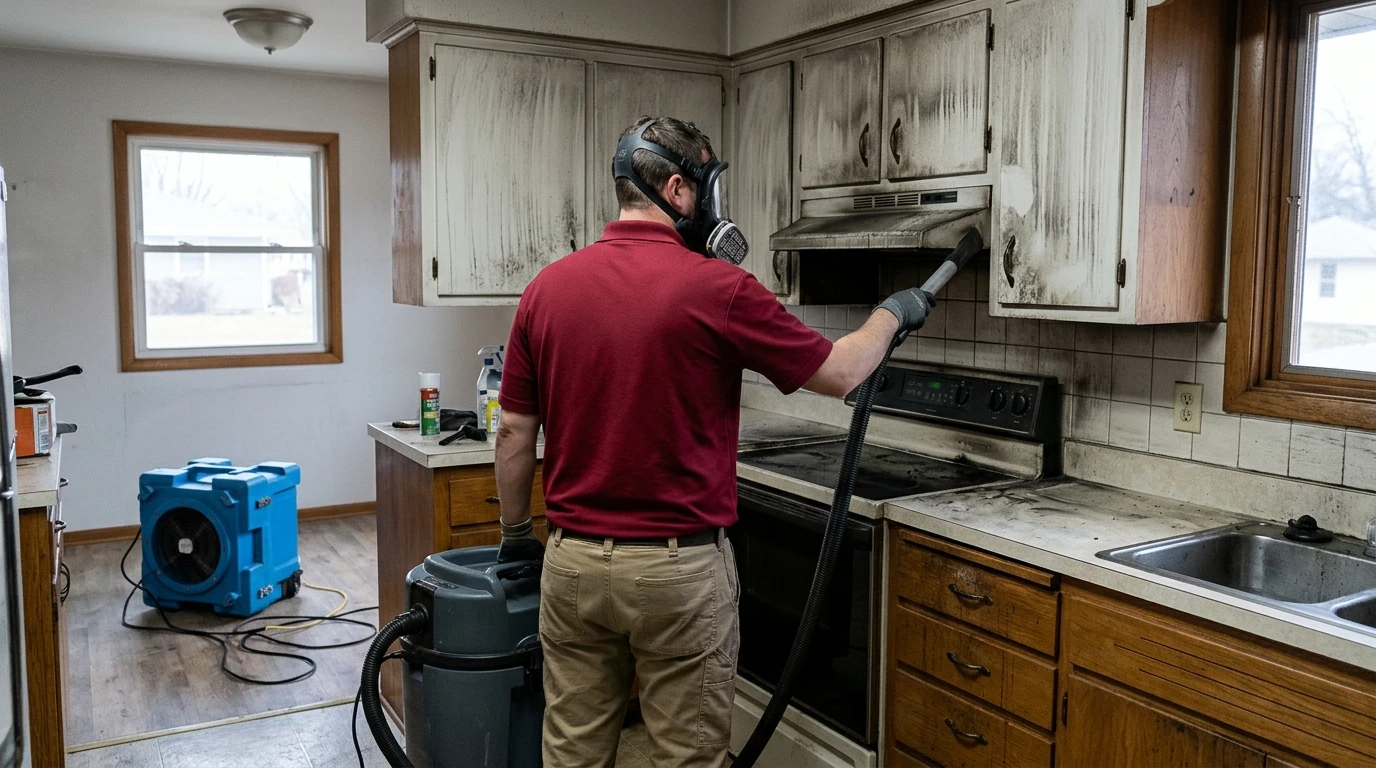
A restoration crew assesses the smoke damage, removes or treats affected materials, and deep-cleans the air and surfaces using equipment a homeowner doesn’t own. That’s the short version. Here’s what it looks like room by room.
Crews work under the ANSI/IICRC S700 Standard for Professional Fire and Smoke Damage Restoration, which separates jobs by the type of smoke: dry smoke from a fast, hot fire (like a grease fire) leaves powdery residue that’s easier to clean; wet smoke from a smoldering fire leaves a sticky, smeary film that’s harder to remove and smells worse. A furnace puffback leaves a third kind, a fine oily soot, that spreads through ductwork into rooms that never saw flame.
The process usually runs in this order:
- Assess the source and category of smoke, and check for hidden damage in wall cavities or attic space.
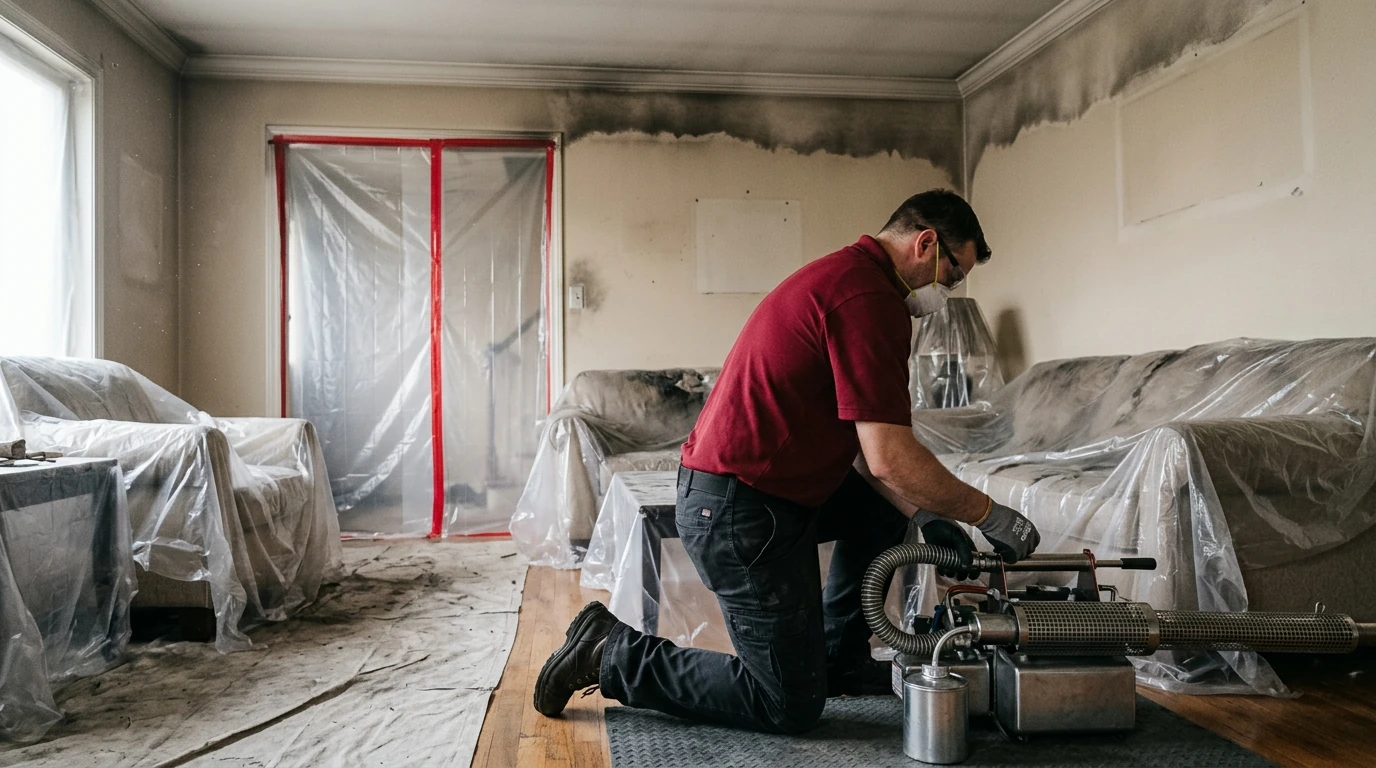
- Contain the affected area to stop soot from spreading further through HVAC ducts or open doorways.
- Remove porous materials that can’t be cleaned (charred drywall, some insulation, certain textiles).
- HEPA vacuum and wipe down hard surfaces, followed by thermal fogging or an ozone or hydroxyl treatment for odor.
- Run air scrubbers until air quality testing shows the smoke smell is gone, not just masked.
For losses that touch structural materials or require rebuilding drywall and trim, that work typically folds into reconstruction. If the fire department broke a window or door to fight the fire, emergency board-up happens the same day, before cleanup even starts, to keep weather and intruders out.
What should I throw away after smoke damage, and are my smoke-damaged clothes safe to keep?
As a rule, throw away anything porous that absorbed smoke and can’t be fully deep-cleaned: opened food, most plastics near the fire, foam cushions, and items with charring. Clothing and linens are usually salvageable if they’re laundered with a specialized process, but not with a normal wash cycle.
Home washing machines don’t get hot enough or agitate long enough to break the bond between smoke particles and fabric fibers. That’s why clothes that get run through a regular laundry cycle often still smell like smoke weeks later, even after multiple washes. A contents restoration program uses ultrasonic cleaning, ozone chambers, and specialized detergents built for soot removal, which is a different process than anything available at home.
Documents, photos, and electronics are worth having evaluated individually rather than assumed as a loss. Furniture with a solid wood or metal frame is often salvageable; upholstered furniture is a case-by-case call depending on how deep the smoke penetrated.
Why does smoke odor come back after I’ve already cleaned?
Smoke odor returns because the particles that cause it are microscopic and get trapped in porous materials, carpet padding, and HVAC ductwork, not just on visible surfaces. Wiping down walls and running an air freshener only masks the smell temporarily; it doesn’t remove the source.
Heat and humidity reactivate trapped smoke particles, which is why a house can smell clean in October and smell like smoke again on a humid July afternoon. If soot made it into your furnace or ductwork, every time the system runs it recirculates the odor through rooms that were never near the fire. That’s a common reason homeowners end up calling a restoration company a second time after trying to handle a small fire themselves. More detail on why this happens and what actually removes it is in how professionals remove smoke odor.
What should I do before the restoration crew arrives?
Don’t touch soot-covered surfaces with a dry cloth or vacuum without a HEPA filter; both spread fine particles deeper into fabric and carpet instead of removing them. Open windows briefly if it’s safe and the weather allows, turn off your HVAC system to stop it from circulating soot through the ducts, and avoid cooking or running appliances until the system has been checked.
Take photos of every affected room before anything is moved or cleaned, for your insurance file. Keep receipts for any temporary lodging, since most homeowners policies include additional living expense coverage when a home is unsafe to occupy (Triple-I overview of standard homeowners coverage). The U.S. Fire Administration’s guidance for after a home fire covers additional safety steps for the first 24 hours.
Once the area is safe, schedule a smoke damage assessment so a written scope of work exists before cleanup starts; that scope is what your adjuster will reference when approving the claim.
Every fire is different, and the scope above depends on the size and type of the loss, so get an on-site assessment before assuming what’s salvageable.
Need help now? Call Crew Restoration & Construction at (605) 965-2727.