TL;DR: For mold remediation in Sioux Falls, SD, you need an IICRC-certified crew that follows containment, removal, and clearance testing protocols. Most residential jobs run $1,500 to $6,000 depending on the affected area and materials involved. Mold spreads fast, especially in South Dakota’s humid summers, so getting a professional assessment within 24 to 48 hours of discovery matters.
If you just found mold in your basement, behind drywall, or under a bathroom vanity, you’re probably wondering whether this is a DIY bleach job or something that needs a professional. The short answer: if the affected area is larger than 10 square feet, or if you don’t know the moisture source, you need a certified remediation company. Here’s what the process looks like, what to watch for, and how to find a qualified crew in the Sioux Falls metro.
What Does Professional Mold Remediation Actually Involve?
Professional mold remediation is a structured, multi-phase process, not just spraying and wiping. A certified crew contains the affected area, removes contaminated materials, cleans and treats surfaces, dries the space, and verifies clearance with post-remediation testing before reopening the area.
The IICRC S520 standard is the industry benchmark for mold remediation. It defines three condition levels: Condition 1 (normal), Condition 2 (settled spores, no visible growth), and Condition 3 (actual mold growth present). A legitimate remediation company will assess which condition you’re dealing with before recommending a scope of work.
Here’s what each phase typically involves:
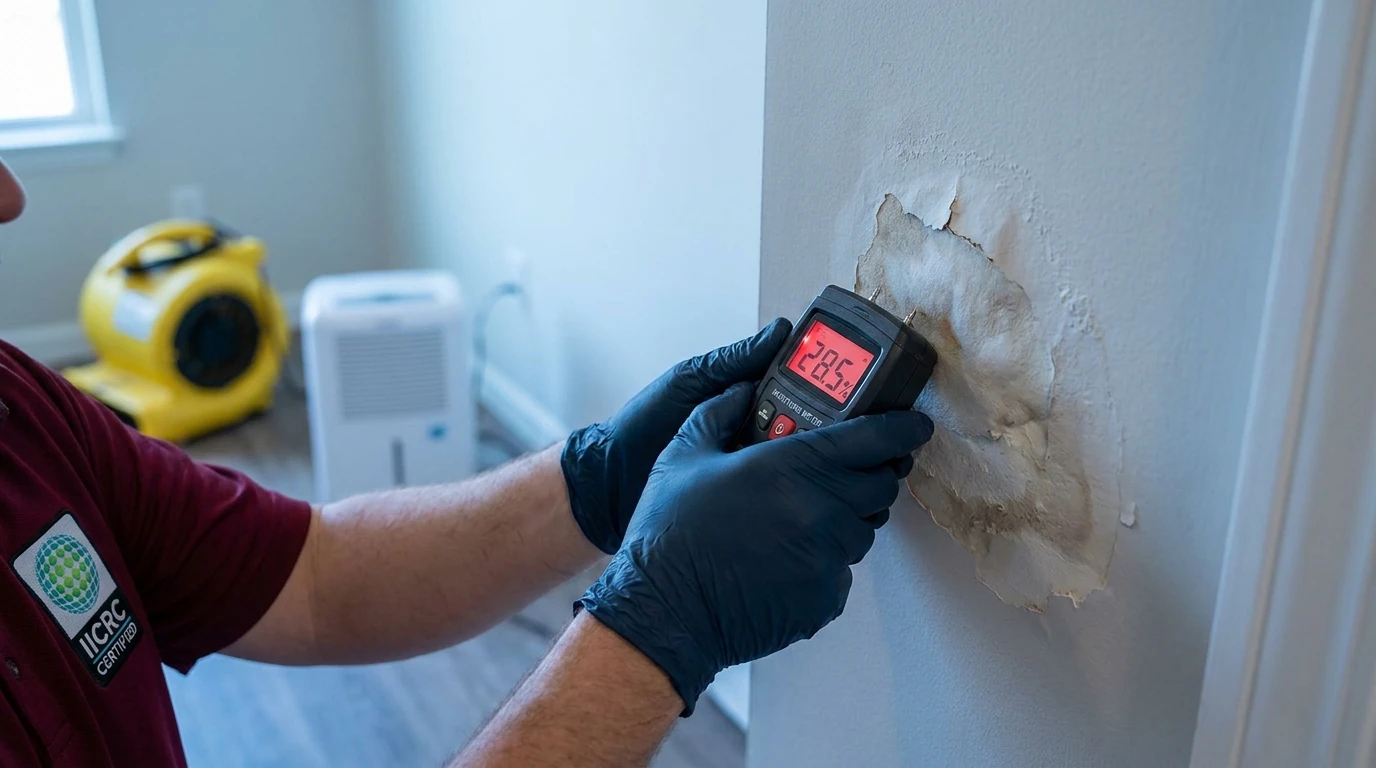
- Assessment and moisture mapping. A technician uses a moisture meter and sometimes a thermal camera to find all wet areas, not just the visible mold. You can’t remediate mold without fixing the moisture source first.
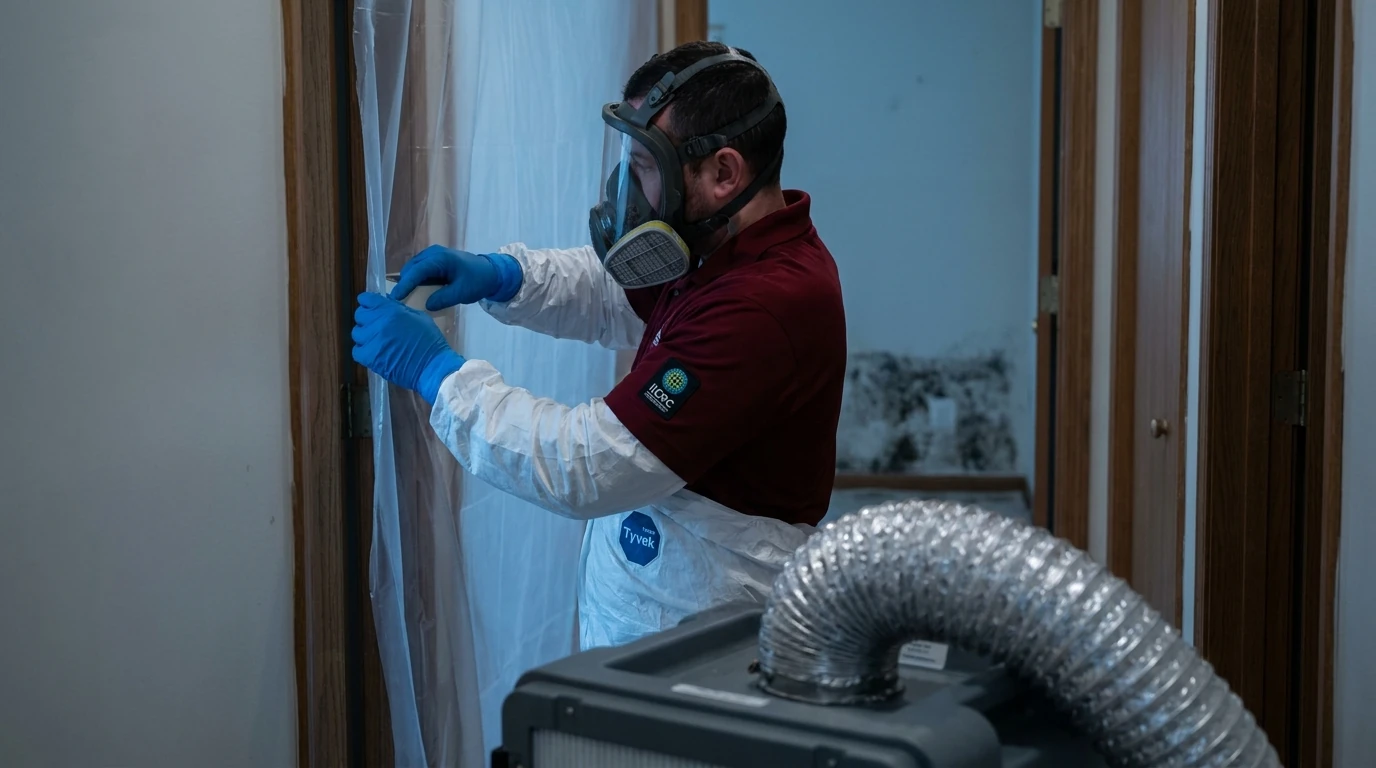
- Containment setup. Poly sheeting seals off the work area. Negative air pressure (using an air scrubber exhausted outside) keeps spores from migrating to clean parts of the house.
- Material removal. Porous materials with mold growth, typically drywall, insulation, and carpet, are bagged and disposed of per EPA guidelines. Non-porous surfaces are HEPA-vacuumed and treated.
- Cleaning and antimicrobial treatment. Structural framing and surfaces are cleaned and treated. Some crews use encapsulants on wood framing after cleaning.
- Drying. If the moisture source was a leak or flood, the space needs to dry completely before reconstruction. This is often where a dehumidifier and air movers run for several days.
- Clearance testing. A post-remediation verification (PRV) test, ideally done by a third party, confirms spore counts are back to normal levels before the area is closed up.
For more on how quickly mold develops after water intrusion, see How Quickly Does Mold Grow After Water Damage?
How Do You Find a Qualified Mold Remediation Company Near You?
The best mold remediation company near you holds IICRC certification, carries liability insurance, provides a written scope of work before starting, and does not also sell you the clearance test (that’s a conflict of interest).
In Sioux Falls and the surrounding area, here’s what to look for when vetting a company:
- IICRC certification in mold remediation (AMRT or WRT). Ask for the technician’s certification number, not just the company’s general claim.
- Written scope before work begins. Any reputable company will provide a detailed scope of work and a line-item estimate. Walk away from anyone who quotes verbally and starts immediately.
- Clearance testing offered separately. The company remediating should not also be the one certifying the job complete. Independent industrial hygienists or third-party testers provide unbiased results.
- Insurance documentation. Ask for a certificate of insurance showing general liability and workers’ compensation. Mold jobs involve demolition and potential spore exposure, and you don’t want liability for an uninsured worker.
- No guarantees of zero mold. Mold spores exist everywhere in the environment. A legitimate company promises to return your home to normal fungal ecology, not to eliminate all spores.
For Sioux Falls homeowners in neighborhoods like McKennan Park or All Saints, where older housing stock means more original drywall and wood framing, containment and clearance testing are especially important. Older materials absorb moisture differently and can harbor mold deeper into the substrate.
If you’re unsure whether you have a mold problem at all, read How To Test for Mold in Your Home before calling anyone.
Will Homeowners Insurance Cover Mold Remediation in South Dakota?
Homeowners insurance in South Dakota typically covers mold remediation only when the mold results from a covered peril, such as a sudden pipe burst or appliance failure. Mold from a slow leak, ongoing condensation, or deferred maintenance is almost always excluded.
Here’s the practical breakdown:
- Covered scenario: A pipe bursts behind your wall in a Cathedral Historic District bungalow. You file a water damage claim. The adjuster finds mold behind the drywall during the inspection. Because the mold is a direct result of the covered water event, remediation is typically included in the claim.
- Not covered: You notice a musty smell in your Prairie Green basement. A contractor finds mold that’s been growing for months from a slow foundation seep. That’s maintenance-related and most policies won’t pay.
- Gray area: A roof leak after a hailstorm causes attic mold. Storm damage is a covered peril, but your insurer may argue the mold developed over time. Document everything and push back with dated photos.
The EPA’s mold guidance is worth reading before your adjuster visit. It establishes what “normal” remediation looks like and can help you push back on a lowball scope.
For a deeper look at what South Dakota policies actually pay, see Does Homeowners Insurance Cover Mold?
One practical tip: start the remediation process before waiting for full claim approval. Most adjusters expect you to mitigate promptly. Waiting for a green light while mold spreads can actually hurt your claim.
What Should You Do Right Now If You Found Mold?
If you found mold today, stop the moisture source first, then call a certified remediation company for an assessment. Do not disturb the mold before the assessment, and do not run your HVAC system, which can spread spores throughout the house.
Here’s the immediate checklist:
- Fix or shut off the water source if the mold is tied to a leak.
- Turn off your HVAC system or close the vents in the affected area.
- Don’t scrub, bleach, or disturb the mold before a professional assessment. Disturbing mold releases spores.
- Take photos and note the date. This documentation matters for insurance.
- Call an IICRC-certified remediation company for an assessment, not just a phone quote.
- Notify your insurance company if the mold is tied to a covered event.
For Sioux Falls homeowners, Crew Restoration & Construction (IICRC-certified, licensed in SD, serving the metro since 2015) handles mold remediation assessments and can coordinate the full scope from containment through clearance. Reach them at (605) 965-2727.
If you’re not sure whether what you’re seeing is actually mold, read Black Mold vs Regular Mold: How To Tell the Difference before calling.
About Crew Restoration & Construction
Crew Restoration & Construction is an IICRC-certified restoration company based in Sioux Falls, SD, serving the metro and surrounding communities since 2015 (SD license 3814). Their services include mold remediation, water damage restoration, fire damage restoration, storm damage restoration, sewage cleanup, biohazard cleanup, asbestos abatement, and general contracting. Estimates can be requested at [email protected] or by calling (605) 965-2727.